


Snap-on EEDM604F: digital multimeter with triple display
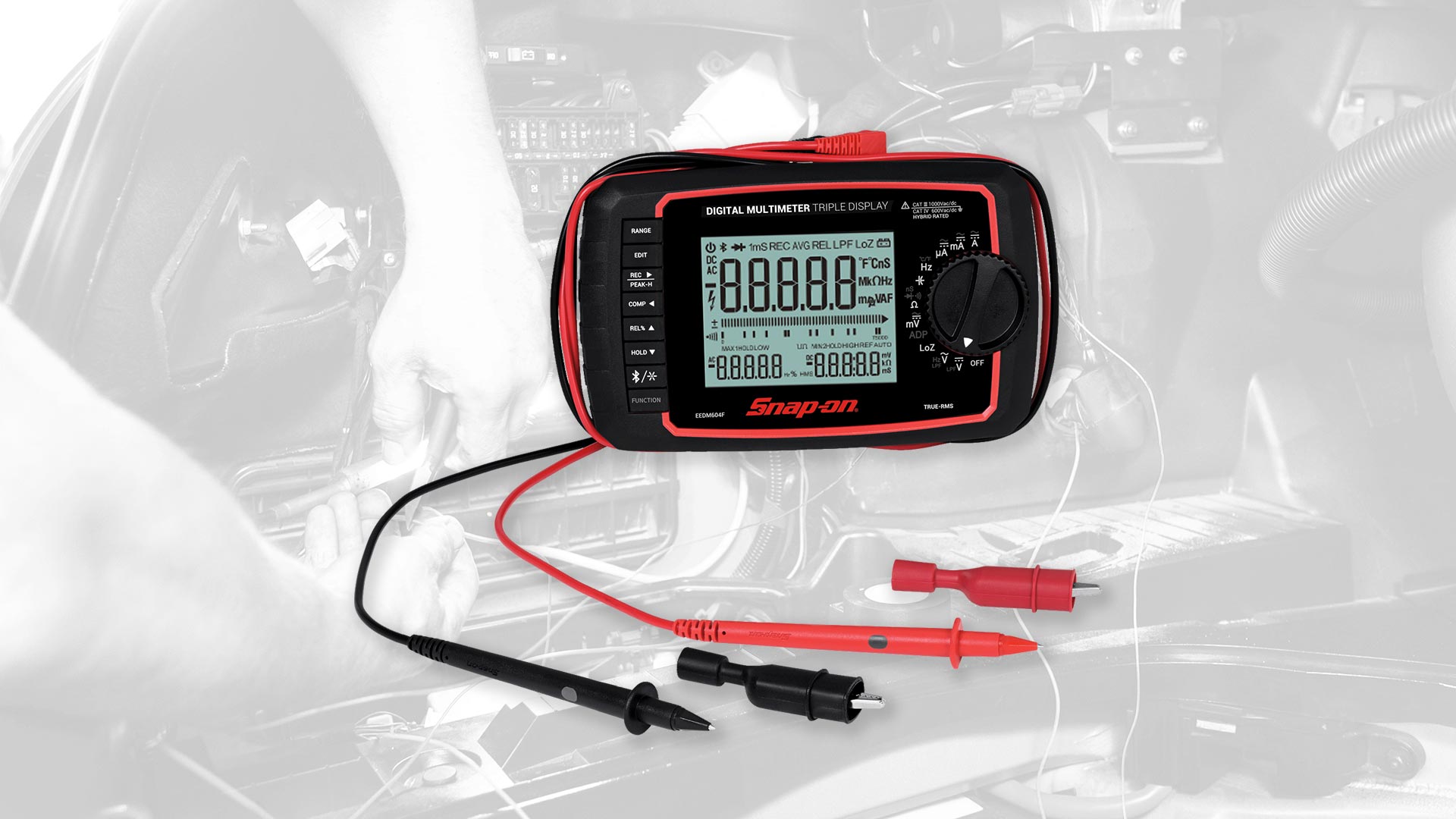
A multimeter is one of the most commonly used and essential tools in the workshop. Yet technicians regularly face the same challenges: a display that is difficult to read, test leads that are just a little too short, or a reading that disappears before you’ve had a chance to look at it. The Snap-on EEDM604F has been designed with these practical considerations in mind.
Key features of the Snap-on EEDM604F
 Large horizontal 3-in-1 display
Control via buttons and a dial
Free Bluetooth app for wireless data retrieval
Saving and sharing measurement results and customer data
CAT-III 1,000 V / CAT-IV 600 V hybrid safety classification
Storage bag with fastening strap
Built-in tilt stand
Horizontal triple display
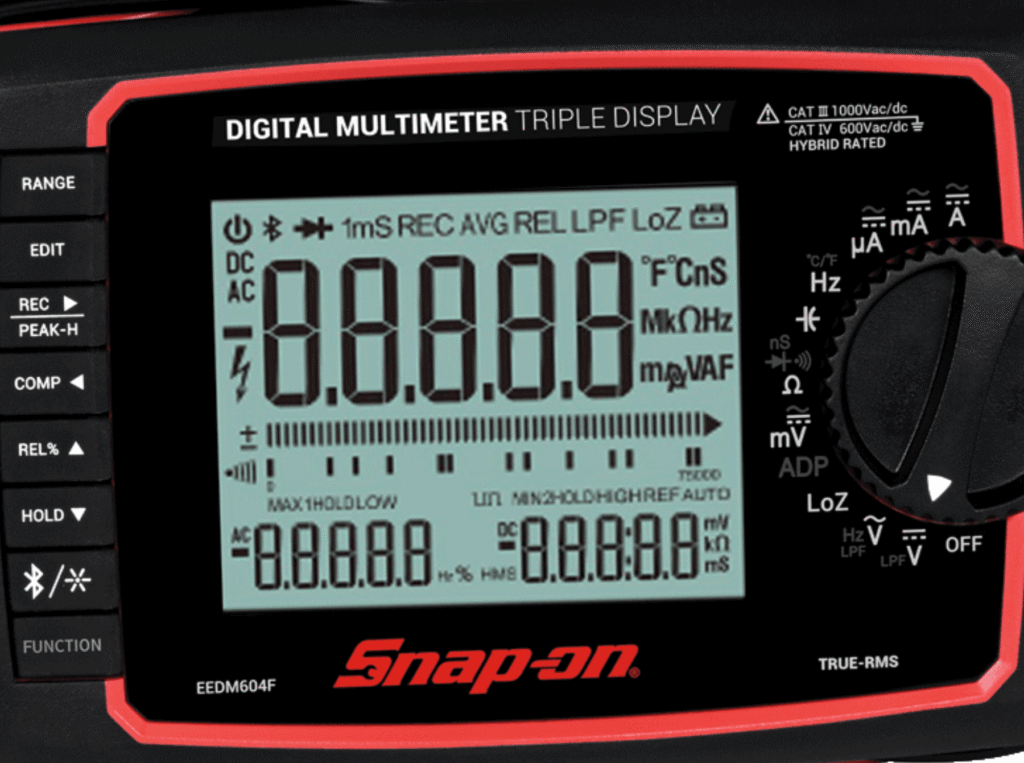
The most striking feature of the EEDM604F is the orientation of its screen. Whereas a standard multimeter has a narrow vertical display, this screen is positioned horizontally. This allows for a larger display without making the casing too bulky. The display shows three sections simultaneously: the main display showing the current reading, and two secondary displays for additional information such as minimum, maximum or a reference value.
The backlight ensures the screen remains legible in a dark engine compartment or under the dashboard. The controls are centred around a central rotary knob for the measurement function, supplemented by two dedicated buttons on the side. No need to scroll endlessly through menus.
Remote measurement via Bluetooth
The meter has built-in Bluetooth and works in conjunction with a free app, available from the App Store and Google Play Store. This combination opens up possibilities that aren’t feasible with a standard multimeter. A practical example: testing brake lights. Normally, you need two people, or you have to secure the brake pedal. With the EEDM604F, you simply connect the meter to the brake light connector, walk over to the driver’s seat and operate the brake pedal whilst reading the readings live on your phone. The same principle applies when testing indicators, reversing camera power supply or charging cable connections on an EV.
This is even more relevant for lorries and buses. Gear-shift signals, retarder settings or ABS sensors on the rear axle can be monitored whilst driving, with the phone kept in plain view in the cab. The app stores measurement results and customer data. This is useful for reporting, but also for comparing measurements in the event of recurring complaints.
Measuring what you can’t see
Not every fault is permanently visible. The REC function records the minimum, maximum and average values over a measurement period. Examples include a battery that drops in voltage under certain loads, a sensor that gives an abnormal reading under specific conditions, or a charging voltage that fluctuates whilst the engine is running. The REC function records this, even if you are not looking at the screen at the time.
Some faults appear and disappear in the blink of an eye. A brief voltage spike in an injector signal, a failure in a wheel speed sensor or a temporary contact issue. The PEAK-H function records spikes down to a single millisecond. This makes it possible to detect faults that simply cannot be seen on a standard meter.
The Hold function freezes the last two readings on the display. This is useful at hard-to-reach measurement points, but also when you cannot move the test leads to a better-lit area. It makes it easier to compare readings.
Compare in detail
The REL function compensates for cable resistance to provide a more accurate result. This is useful for low-resistance measurements, such as ground connections or coil resistances. REL can also be used for differential measurements: set a reference value and measure the difference relative to that value.
COMP compares a measured value with a known standard. This standard value is set using the EDIT button and the arrow keys. This makes it easy to see whether a sensor, resistance or voltage falls within the expected range.
The LoZ (Low Impedance) setting filters out phantom voltage and interference from nearby wiring. Anyone who has ever measured voltage on a wire that wasn’t connected to anything will recognise the problem. LoZ shows the actual situation.
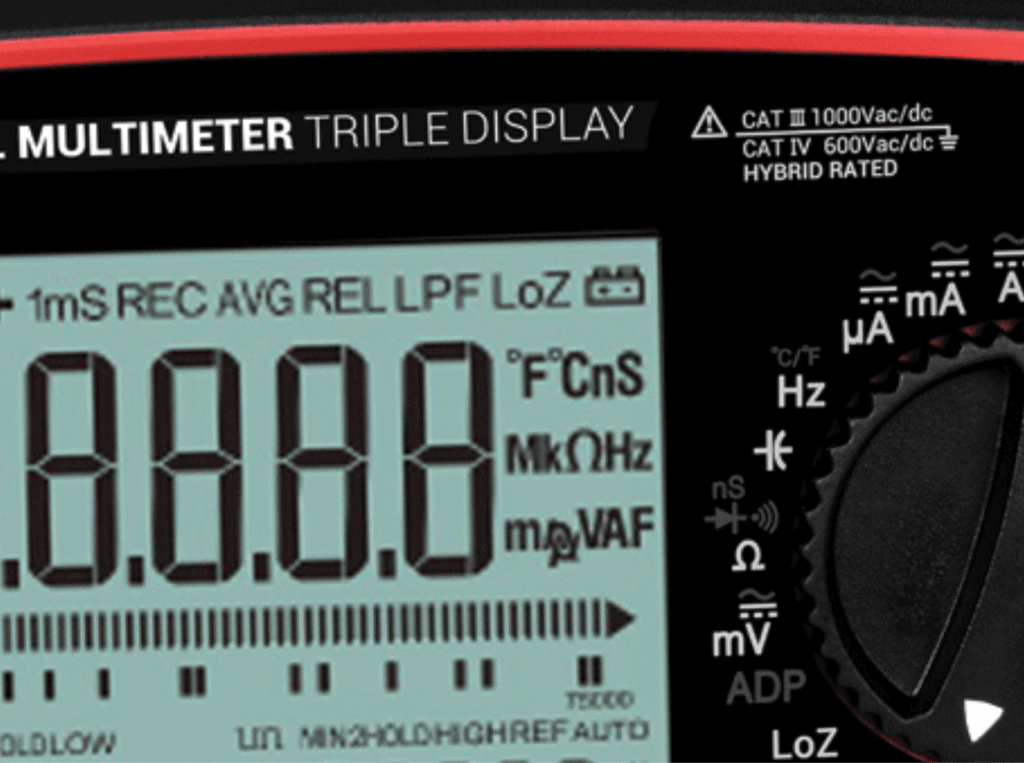
The LPF (low-pass filter) suppresses high-frequency noise at the measurement point. In the case of PWM-controlled components, such as a fan motor or an EGR valve, the LPF stabilises the reading so that the baseline value is clearly visible.
Resistance and capacitance
The meter switches between resistance (Ohms), conductance (nS) and continuity testing with an audible signal. All three are relevant when measuring coil resistances, ground points or contact resistances. The capacitance measurement is useful for checking capacitors in hybrid and electric vehicles, an application that is becoming increasingly common in the workshop. The EEDM604F has a CAT-III 1,000 V / CAT-IV 600 V hybrid safety rating, including suitability for measurements on hybrid and electric vehicles.
The meter is supplied with test leads (EEDMLEADSET), two temperature sensors (EEDMTEMP-2 and EEDMTEMP-3), fuses and a carrying case with a strap for securing the test leads. It features a built-in tilting stand for use on a flat surface. A magnetic hanging strap (EEDMMAGSTRAP) is available as an option for hanging the meter.
Want to know more as a result of this article?
Get in touch
